Plyometric Training can be the fastest way to feel more explosive, but it also tends to be the fastest way to irritate knees, Achilles, or low back when the basics are skipped.
If you want more power for sports, faster sprint starts, higher jumps, or simply that “springy” athletic feel, plyos work because they train your body to absorb force and then rebound quickly. The catch is that your tissues need to tolerate high impact, and your technique needs to stay clean when you get tired.
This guide walks through what plyometrics actually improve, how to know if you’re ready, how to progress without guessing, plus a few practical programs you can run even with limited equipment.

What “power” means in plyometrics (and why it’s not just jumping)
In simple terms, power is force produced quickly. Plyometric work targets the stretch-shortening cycle, the quick “load then explode” action you see in jumping, cutting, throwing, and sprinting.
A good plyometric session usually trains two things at once: your ability to absorb force (landing/braking) and your ability to redirect force (rebounding or taking off again). Many people chase height or distance and ignore the landing, then wonder why ankles and knees feel beat up.
According to the National Strength and Conditioning Association (NSCA), plyometric programs should emphasize sound mechanics, appropriate volume, and progressive overload to manage injury risk and improve performance.
Why Plyometric Training builds power (and when it doesn’t)
Plyometric Training tends to work well when you already have a basic strength foundation and you can control your positions under speed. It often disappoints when someone adds random jump circuits on top of fatigue and hopes “more reps” equals more power.
- Neuromuscular efficiency: you learn to recruit muscle faster, especially in short ground-contact movements like hops and bounds.
- Tendon stiffness and recoil: tendons can store and release energy more effectively, which matters for sprinting and repeated jumps.
- Rate of force development: you get better at producing meaningful force early in the movement, not just grinding through.
When it doesn’t translate: if your landings collapse, if you can’t decelerate, if you’re sore for days after every session, or if your “plyos” are basically cardio with sloppy reps.
Quick readiness checklist (be honest with yourself)
You don’t need to be a powerlifter to start plyos, but you do need a minimum level of joint tolerance, balance, and basic strength. This is the part most people rush.
- Landing control: can you step off a low box and land quietly, stable, and pain-free?
- Ankle and calf tolerance: can you do 20–25 single-leg calf raises per side with full range and no sharp pain?
- Single-leg stability: can you hold a single-leg balance for 30 seconds per side without the foot collapsing?
- Strength baseline (practical, not perfect): you can squat and hinge with good form, and you can do split squats without knee pain.
- Health check: no current flare of Achilles tendinopathy, stress reaction history, or unresolved joint swelling.
If any item is a “no,” you can still move toward power, but it usually means starting with lower-impact options (like jump rope patterns, pogo jumps, med-ball throws) and building capacity.
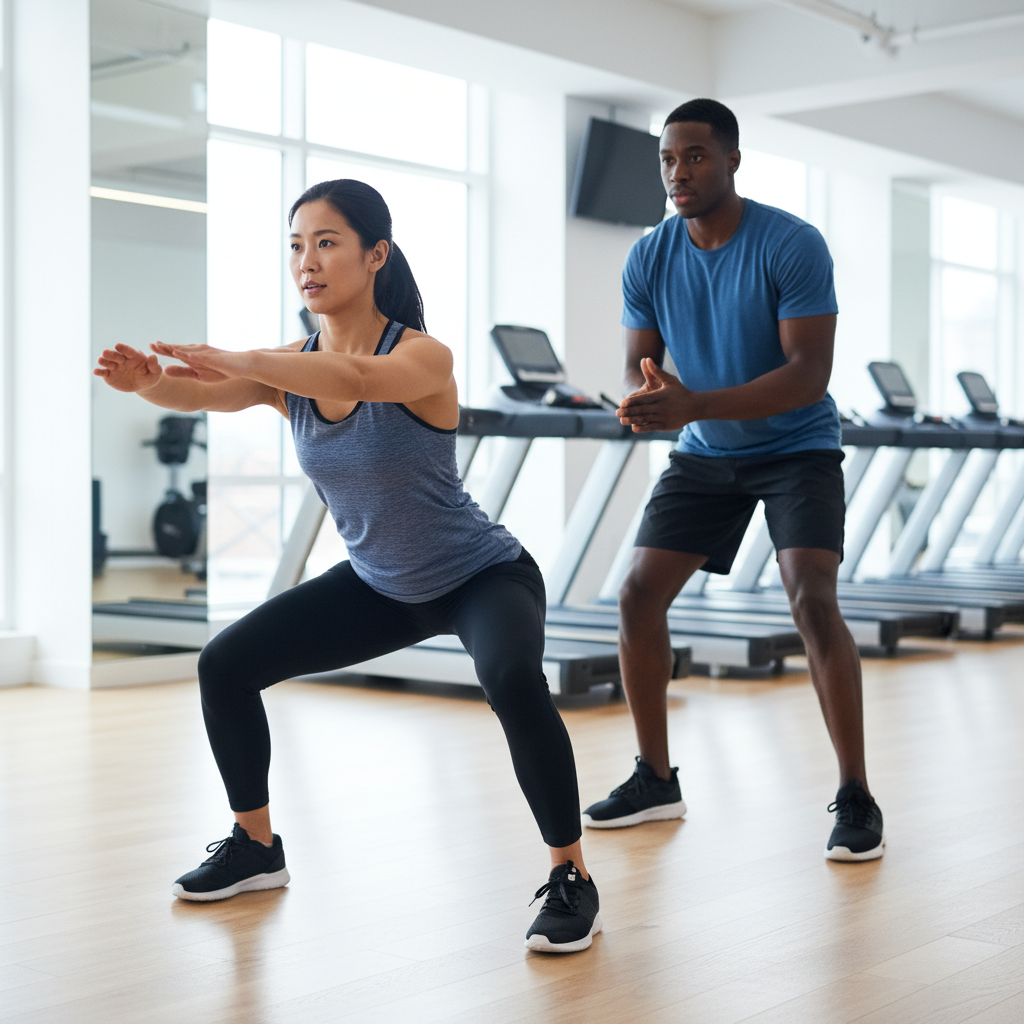
Technique cues that keep plyos productive (and usually safer)
Most coaching cues aim at one thing: letting your joints share load instead of dumping everything into one spot. Keep cues simple so you can remember them at speed.
Landing: the rep starts when you hit the ground
- “Quiet feet”: loud landings often mean poor force absorption.
- Ribs stacked over hips: avoid over-arching the low back to “reach” the jump.
- Knees track with toes: mild inward movement can happen, but sharp collapse is a red flag.
- Use the whole foot: not just toes, not just heels.
Takeoff: stay springy, not grindy
- Short ground contact for pogo-style work (ankle bounce), longer contact for box jumps or broad jumps.
- Stop the set when height drops: quality beats fatigue for power.
If you feel pain that changes your mechanics, that’s a stop sign, not “normal burn.” If you have a history of tendon or joint issues, it’s smart to check in with a qualified coach or clinician.
Programming Plyometric Training: volume, rest, and progression
For power, you want crisp reps with plenty of rest. If your breathing looks like a conditioning circuit, the stimulus shifts away from explosiveness.
Simple rules that work in real life
- Frequency: 1–3 sessions/week depending on sport, lifting volume, and recovery.
- Rest: 60–120 seconds between sets for most jump work, longer if you want maximum output.
- Foot contacts: start low and earn more. Beginners often do well around 40–80 quality contacts in a session; advanced athletes may tolerate more, but it varies.
- Progression: increase complexity or intensity before you increase volume.
A practical progression ladder
- Low impact: line hops, jump rope, pogo jumps, snap-downs.
- Moderate: squat jumps, box jumps, lateral bounds with stick landing.
- Higher: depth jumps, continuous hurdle hops, reactive single-leg hops (only if your base is solid).
Sample workouts (pick the one that matches your goal)
These sessions assume a warm-up with light movement, ankle prep, and a few practice jumps at low intensity. Pair plyos early in the workout, before heavy fatigue.
Workout A: General power (2x/week)
- Box jump: 4 sets x 3 reps, step down each rep
- Broad jump: 4 sets x 2 reps, stick the landing
- Lateral bound to stick: 3 sets x 3 reps/side
- Pogo jumps: 3 sets x 15–20 seconds
Workout B: Sprint-focused bounce (1–2x/week)
- Ankling or A-skips: 3 x 20 meters
- Pogos (stiff ankle): 4 x 10–15 reps
- Single-leg pogo (low amplitude): 3 x 8 reps/side
- Bounds (submax): 3 x 20 meters
Workout C: Low-equipment, joint-friendlier option
- Jump rope: 6 rounds x 20 seconds on, 40 seconds off
- Snap-down to athletic stance: 4 x 4 reps
- Skater hop to stick: 3 x 4 reps/side

How to pair plyometrics with strength training (without frying yourself)
Most people do best when plyos are a small, high-quality “power block,” then strength work follows. You’re training speed and precision, so treat it like a skill.
- Same day pairing: plyos first, then heavy lifts. Example: box jumps before squats.
- Contrast sets (advanced): heavy set, then a similar jump pattern after 2–4 minutes rest. Only if technique stays sharp.
- Avoid stacking impact: if you already run, play basketball, or do lots of sprinting, your plyometric dose often needs to be smaller.
According to the American College of Sports Medicine (ACSM), progression and adequate recovery matter for reducing overuse risk in training programs, especially when intensity increases.
Common mistakes and how to fix them fast
- Doing plyos to exhaustion: cap sets early. If rep height drops or landings get loud, stop that drill.
- Chasing height with ugly mechanics: lower the box, own the landing, then build back up.
- Too much too soon: tendons adapt slower than your motivation. Add intensity gradually.
- Ignoring soreness signals: calf/Achilles stiffness that lingers and worsens session to session often means volume needs a cut.
- All bilateral, no single-leg control: mix in stick landings and bounds to build symmetry, but keep intensity appropriate.
A simple “what should I do?” table
If you’re stuck choosing drills, this quick map usually gets you close without overthinking.
| Goal / Situation | Good Plyo Choices | Keep an Eye On |
|---|---|---|
| New to plyos, want safer entry | Jump rope, line hops, snap-downs, box jumps (low) | Quiet landings, calf soreness lasting >48 hours |
| Need vertical power for basketball/volleyball | Box jumps, squat jumps, approach jumps (limited volume) | Knee cave, low back arching on takeoff |
| Want faster sprint and rebound | Pogos, bounds, low hurdle hops (reactive) | Stiffness in Achilles, hamstring “grabbing” |
| Returning after lower-leg irritation | Low amplitude hops, isometrics, gradual rope work | Pain that increases during session, next-day limp |
Key takeaways (save this)
- Plyometric Training builds power when reps stay explosive and landings stay controlled.
- Start with low-impact drills, then earn reactive and single-leg progressions.
- Keep volume modest, rest longer than you think, and stop sets before form breaks.
- If you have current tendon/joint pain, get guidance from a qualified professional before pushing intensity.
Conclusion: build power by staying picky about quality
Plyos are simple on paper, jump and land, but the difference between progress and nagging pain is usually how well you control the landing and how disciplined you are with volume. Pick a level you can own, run it for 3–6 weeks, then progress one variable at a time.
If you want a clean next step, choose one workout above, keep it twice a week, and track two things: how “quiet” your landings feel and whether you bounce back in 24–48 hours. That feedback loop matters more than any fancy drill.